
When Marketing and Sales Move as One, Startups Grow Faster
Written by Eva Benoit | eva.benoit@evabenoit.com | evabenoit.com

Image by Freepik
In an early-stage company, marketing and sales are often built by different people, at different times, with different incentives. Marketing focuses on awareness and demand, sales chases revenue and closes deals. Without alignment, that split creates friction that quietly drains growth, stalls pipelines, and lets promising prospects slip away.
The strongest startups treat marketing and sales as a single revenue engine. When alignment is intentional, workflows are simple, handoffs are clear, and both teams spend less time debating credit and more time converting customers.
Key Takeaways
Misalignment between marketing and sales usually comes from unclear ownership, vague definitions, and mismatched goals.
Shared revenue targets and agreed lead criteria reduce friction more than extra meetings ever will.
Clean handoffs depend on systems and documentation, not heroic effort.
When both teams plan content together, prospects experience a smoother journey and convert faster.
Why Startups Struggle With Sales and Marketing Alignment
Early-stage companies move fast, often too fast to define processes. Marketing launches campaigns without knowing what sales actually needs, while sales complains about lead quality without explaining why. Each side optimizes for its own metrics, creating silos that feel efficient but break the buyer experience.
The result is predictable. Leads arrive unqualified, sales follows up late or inconsistently, and marketing has no feedback loop to improve targeting. Friction grows because neither team has a shared definition of success.
Turning Shared Spreadsheets Into Clear Reference Docs
Many startups already track lead definitions, funnel stages, or forecasts in spreadsheets that live in inboxes or shared drives. The problem isn’t the data; it’s the lack of a single, reliable reference. Converting those spreadsheets into standardized documents gives both teams something stable to work from. Using an online tool to turn Excel into PDF files can quickly transform working files into clean, shareable artifacts everyone recognizes as final. This reduces version confusion and prevents subtle disagreements over definitions. Over time, these documents become the backbone of consistent handoffs and smoother collaboration.
What Alignment Looks Like in Practice
It helps to compare how alignment shows up day to day.
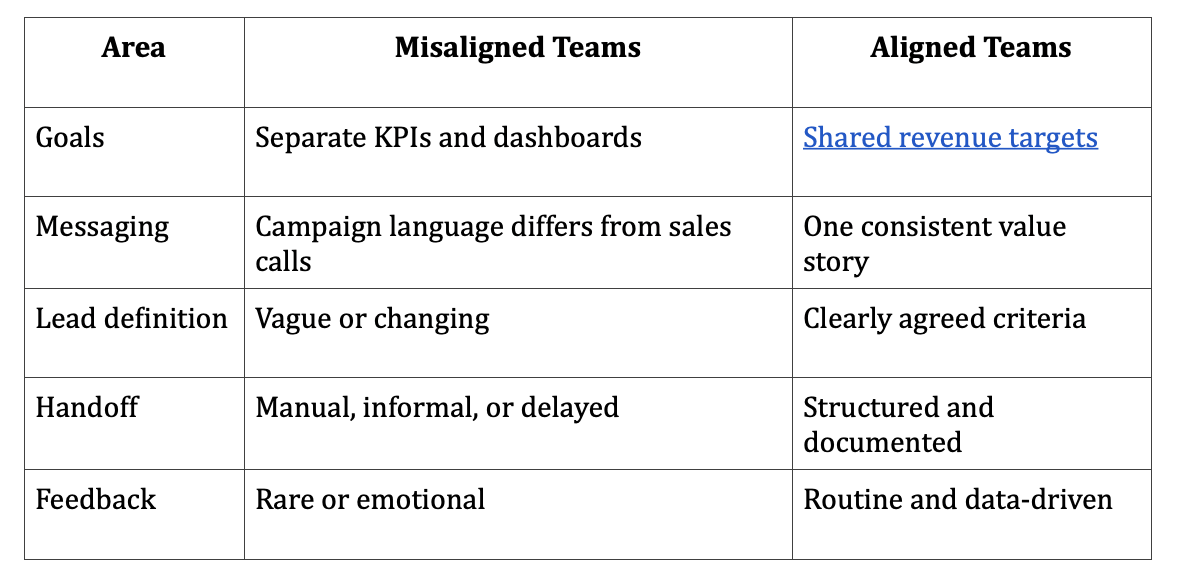
Designing a Clean Lead Handoff
A clean handoff feels invisible to the prospect. Marketing delivers context, sales responds quickly, and the conversation continues without repetition. A messy handoff, by contrast, costs trust, time, and often the deal itself.
To create consistency, teams need a simple, shared process they can rely on every day:
Define exactly what makes a lead “sales-ready,” including behaviors and signals.
Agree on response time expectations and ownership.
Ensure sales receives key context, not just contact details.
Close the loop so marketing knows what converted and why.
How Business Education Can Strengthen Alignment
Founders often learn alignment the hard way, through trial and error. Formal business training accelerates that learning by teaching cross-functional thinking and systems design. Earning an MBA can help owners design clearer workflows, align incentives, and communicate expectations across teams. The strategic perspective gained helps marketing and sales operate as coordinated functions instead of competing departments. Learn more about online programs that make it possible to apply those lessons in real time while running the company.
A Practical Path to Tighter Collaboration
Alignment improves when actions are simple and repeatable. The steps below help teams move from intention to execution:
Set one shared revenue goal and review it together monthly.
Document lead qualification rules and stick to them.
Build content plans jointly so each asset supports a sales conversation.
Use lightweight tools to track handoffs and response times.
Replace ad hoc meetings with written updates and dashboards.
Sales and Marketing Alignment FAQs
Founders evaluating whether their teams are truly aligned often want clarity before investing time or money.
How do I know if our lead handoffs are broken?
If sales frequently ignores leads or marketing can’t explain which campaigns drive revenue, the handoff is likely unclear. Slow response times and repeated prospect questions are also strong signals. Fixing definitions and ownership usually resolves the issue.
Should marketing or sales own lead qualification?
Ownership should be shared but clearly divided. Marketing qualifies based on behavior and fit, while sales validates intent and timing. Agreement on criteria matters more than who “owns” the label.
Do we need more meetings to stay aligned?
More meetings rarely solve alignment problems. Clear documentation and shared dashboards reduce the need for constant syncs. Meetings should focus on insights, not status updates.
What tools actually help without adding complexity?
Simple CRM workflows, shared documents, and basic reporting often outperform complex stacks. The goal is visibility and consistency, not automation for its own sake. Choose tools that both teams will actually use.
How quickly should sales follow up on new leads?
Speed matters, especially in competitive markets. Same-day follow-up is a strong baseline, with faster responses for high-intent leads. Alignment ensures these expectations are realistic and enforced.
What’s the real payoff of alignment?
Aligned teams close more deals in less time. Sales cycles shorten because prospects experience less friction. Customer relationships also start stronger, setting the stage for retention and growth.
In Closing
Marketing and sales don’t need to compete for recognition in a startup. When they share goals, speak with one voice, and rely on simple systems, growth accelerates naturally. Alignment isn’t about perfection; it’s about clarity and trust. For founders, investing in that clarity early pays dividends at every stage of scale.